Your input will help us improve your experience.You can close this popup to continue using the website or choose an option below to register in or login.
The word crisis often carries such a dramatic connotation, but for most students it’s more commonly experienced in quieter, everyday moments.
It could be a failed assessment, mounting financial pressure, uncertainty about the future, or the emotional strain of trying to meet competing expectations. These moments may not feel like crises, but they shape students’ confidence, wellbeing, and capacity to lead themselves through uncertainty.
Learning how to respond to these setbacks with clarity, emotional intelligence, and resilience is a core life skill, according to Dr Ramani Gallellage, a Senior Lecturer at Nottingham Business School.
Through her work with students and her ‘Believe in Me’ crisis leadership training programme, she explores how emotional intelligence, self-leadership, and small mindset shifts can help students navigate pressure without burning out.
What crisis leadership looks like for students
University students face a wide range of challenges in their everyday life, navigating a highly complex landscape where they are affected by global instability, rapid technological change, and the constant comparison culture driven by social media. All of this is without even mentioning any academic expectations.
Your crisis leadership skills are how you respond to these challenges. As Dr. Gallellage explained, “Leadership in university isn’t about a title or a role, it’s about how you respond when things don’t go according to plan.”
From a leadership theory perspective, effective crisis leadership relies on three core capabilities: sense-making, emotional regulation, and adaptive action.
In practice, this means helping yourself and others interpret complex situations, manage emotions and move forward even when information is incomplete.
Try this: Think of a recent challenge in university. How did you respond? Which of the three crisis leadership capabilities (sense-making, emotional regulation, or adaptive action) did you apply, and which could you practise more next time?

Why stress shrinks thinking
Stress is inevitable at university, but when it becomes constant, it can start to chip away at emotional intelligence and clear thinking.
“From a psychological perspective, stress narrows cognitive capacity and reduces emotional regulation, making it more difficult for students to communicate effectively, reflect clearly, and make balanced decisions,” said Dr. Gallellage.
However, the great thing is that emotional intelligence is not a fixed trait but rather a capability that can be developed with consistent everyday practices.
When students intentionally cultivate self-awareness, emotional regulation, empathy, and reflective thinking, stressful situations can easily be reframed as learning and leadership development opportunities rather than sources of defeat or disengagement.
Students with stronger emotional intelligence consistently show higher levels of resilience, more effective communication, improved teamwork, and stronger academic engagement.
“When stress is supported appropriately, it can become a powerful catalyst for personal growth and leadership maturity,” said Dr Gallellage.
Try these small routine changes to improve your emotional intelligence:
Regular reflective journaling or self-reflection to process experiences and identify behavioural patterns
Active listening and perspective-taking to build empathy and stronger interpersonal relationships
Proactively seeking academic or wellbeing support, recognising that asking for help reflects emotional maturity and leadership awareness
Most of the decisions we have to make in life, often have to be made under uncertainty. This uncertainty can feel truly uncomfortable and the instinctive response of many of us would be to wait for more information, more confidence, or the right moment. But as Dr Gallellage points out, this waiting often creates more pressure rather than less.
“One of the most important lessons we teach in crisis leadership education is that perfect information rarely arrives,” she said.
“Effective decision-making is not about eliminating uncertainty. It is about learning to move forward responsibly despite it.”
Another key reason you might feel stuck is emotional overload. Anxiety can narrow thinking and create a sense of paralysis, making even simple decisions feel overwhelming.
So, in such situations, Dr Gallellage encourages students to first stabilise their emotional state before focusing on finding solutions. Pausing, breathing, and creating some psychological distance from the problem allows clearer thinking. In her crisis leadership training, Dr Gallellage introduces the STOP framework, which encourages students to ‘deliberately pause before reacting.’
Stop: Interrupt automatic reactions
Take a breath: Calm the stress response
Observe: Notice thoughts, emotions, and context
Proceed: Respond intentionally rather than reactively
To be able to effectively make decisions, one should also be able to distinguish between pressure that supports growth and stress that leads to burnout. Not all pressure is harmful.
“A healthy challenge, while demanding, can feel purposeful and connected to learning,” said Dr Gallellage.
Harmful stress, on the other hand, drains energy over time. It shows up as persistent exhaustion, emotional withdrawal, declining motivation, and reduced well-being.
To help students make this distinction, Dr Gallellage encourages regular self-reflection through a simple question: ‘Is this experience stretching me or shrinking me?’
If the situation is expanding skills and confidence, it is likely a healthy developmental challenge. If it consistently diminishes energy, self-belief, and well-being, then adjustment, support, or intervention is needed.
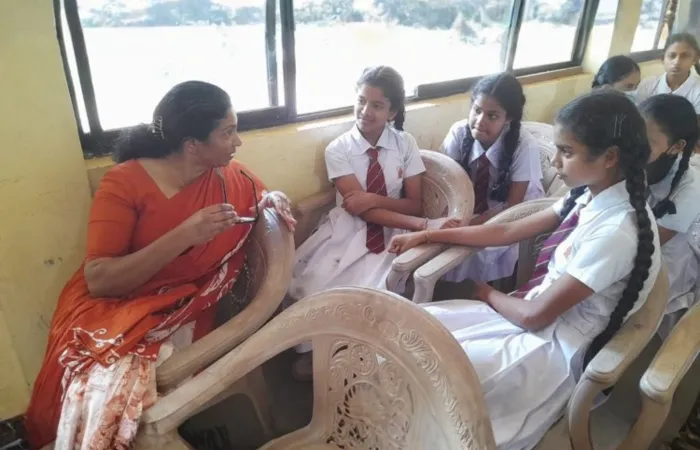
Dr. Gallellage delivering crisis leadership training to Sri Lankan schoolchildren
Building confidence before graduation
When approaching graduation, it’s not unheard of for students to feel that their confidence is becoming more fragile. Through her work with final-year students across different countries and education systems, Dr Gallellage observed a consistent pattern.
“Many students begin to question whether they are truly ready for the workplace, whether their skills will translate beyond academia, and whether they have done ‘enough’ to justify confidence in their next steps”.
At the same time, concerns about final degree classification, comparison with peers, and regret about earlier years can create a sense of urgency and self-doubt. For some, this leads to imposter syndrome and the belief that it may already be too late to improve outcomes.
Dr Gallellage highlights that confidence gaps can look different across education systems. While many Western universities offer structured employability and mentoring support, students from less resourced systems, particularly from the Global South, may face greater uncertainty as graduation approaches, alongside added cultural and family expectations.
“Ultimately, confidence does not develop from perfection or ideal outcomes alone. It grows through evidence of progress, adaptability, reflective learning, and the ability to respond constructively to setbacks,” she explained.
When students are encouraged to see their university experience as a long-term developmental journey rather than a single final result, fear-based thinking gradually gives way to growth-oriented confidence.
Try these small habits to build real confidence over time:
Take time each week to review what you have achieved.
Record small wins to shift attention away from perceived shortcomings towards evidence of growth.
Actively engage in personal and professional development (skills workshops, online courses, career events, etc).
Seek feedback early and work closely with lecturers, supervisors, and mentors.
Learn to interpret feedback constructively.
Learn to reframe negative self-talk and develop a positive internal narrative.
Think intentionally about your future direction (set short- & long-term goals, a personal vision, and a mission statement).
Try to get practical experiences (paid employment, volunteering) to strengthen your confidence by expanding networks and developing transferable skills.
Across her work, from rural schools in Sri Lanka to universities in the UK and beyond, one message remains constant: leadership potential exists everywhere.
When students are supported to develop crisis leadership skills, emotional intelligence, and reflective growth habits, universities are not simply producing graduates.
They are shaping resilient, ethical global citizens equipped to navigate uncertainty with confidence, clarity, and purpose.
Views
Why confidence and leadership skills matter more than grades
Keshala Jayawickrama
Updated Feb 09, 2026Save
Share
Share via
Share this Page12
Table of contents
Table of contents
The word crisis often carries such a dramatic connotation, but for most students it’s more commonly experienced in quieter, everyday moments.
It could be a failed assessment, mounting financial pressure, uncertainty about the future, or the emotional strain of trying to meet competing expectations. These moments may not feel like crises, but they shape students’ confidence, wellbeing, and capacity to lead themselves through uncertainty.
Learning how to respond to these setbacks with clarity, emotional intelligence, and resilience is a core life skill, according to Dr Ramani Gallellage, a Senior Lecturer at Nottingham Business School.
Through her work with students and her ‘Believe in Me’ crisis leadership training programme, she explores how emotional intelligence, self-leadership, and small mindset shifts can help students navigate pressure without burning out.
What crisis leadership looks like for students
University students face a wide range of challenges in their everyday life, navigating a highly complex landscape where they are affected by global instability, rapid technological change, and the constant comparison culture driven by social media. All of this is without even mentioning any academic expectations.
Your crisis leadership skills are how you respond to these challenges. As Dr. Gallellage explained, “Leadership in university isn’t about a title or a role, it’s about how you respond when things don’t go according to plan.”
From a leadership theory perspective, effective crisis leadership relies on three core capabilities: sense-making, emotional regulation, and adaptive action.
In practice, this means helping yourself and others interpret complex situations, manage emotions and move forward even when information is incomplete.
Try this: Think of a recent challenge in university. How did you respond? Which of the three crisis leadership capabilities (sense-making, emotional regulation, or adaptive action) did you apply, and which could you practise more next time?

Why stress shrinks thinking
Stress is inevitable at university, but when it becomes constant, it can start to chip away at emotional intelligence and clear thinking.
“From a psychological perspective, stress narrows cognitive capacity and reduces emotional regulation, making it more difficult for students to communicate effectively, reflect clearly, and make balanced decisions,” said Dr. Gallellage.
However, the great thing is that emotional intelligence is not a fixed trait but rather a capability that can be developed with consistent everyday practices.
When students intentionally cultivate self-awareness, emotional regulation, empathy, and reflective thinking, stressful situations can easily be reframed as learning and leadership development opportunities rather than sources of defeat or disengagement.
Students with stronger emotional intelligence consistently show higher levels of resilience, more effective communication, improved teamwork, and stronger academic engagement.
“When stress is supported appropriately, it can become a powerful catalyst for personal growth and leadership maturity,” said Dr Gallellage.
Try these small routine changes to improve your emotional intelligence:
Testimonials
Decision-making amidst uncertainty and stress
Most of the decisions we have to make in life, often have to be made under uncertainty. This uncertainty can feel truly uncomfortable and the instinctive response of many of us would be to wait for more information, more confidence, or the right moment. But as Dr Gallellage points out, this waiting often creates more pressure rather than less.
“One of the most important lessons we teach in crisis leadership education is that perfect information rarely arrives,” she said.
“Effective decision-making is not about eliminating uncertainty. It is about learning to move forward responsibly despite it.”
Another key reason you might feel stuck is emotional overload. Anxiety can narrow thinking and create a sense of paralysis, making even simple decisions feel overwhelming.
So, in such situations, Dr Gallellage encourages students to first stabilise their emotional state before focusing on finding solutions. Pausing, breathing, and creating some psychological distance from the problem allows clearer thinking. In her crisis leadership training, Dr Gallellage introduces the STOP framework, which encourages students to ‘deliberately pause before reacting.’
To be able to effectively make decisions, one should also be able to distinguish between pressure that supports growth and stress that leads to burnout. Not all pressure is harmful.
“A healthy challenge, while demanding, can feel purposeful and connected to learning,” said Dr Gallellage.
Harmful stress, on the other hand, drains energy over time. It shows up as persistent exhaustion, emotional withdrawal, declining motivation, and reduced well-being.
To help students make this distinction, Dr Gallellage encourages regular self-reflection through a simple question: ‘Is this experience stretching me or shrinking me?’
If the situation is expanding skills and confidence, it is likely a healthy developmental challenge. If it consistently diminishes energy, self-belief, and well-being, then adjustment, support, or intervention is needed.
Dr. Gallellage delivering crisis leadership training to Sri Lankan schoolchildren
Building confidence before graduation
When approaching graduation, it’s not unheard of for students to feel that their confidence is becoming more fragile. Through her work with final-year students across different countries and education systems, Dr Gallellage observed a consistent pattern.
“Many students begin to question whether they are truly ready for the workplace, whether their skills will translate beyond academia, and whether they have done ‘enough’ to justify confidence in their next steps”.
At the same time, concerns about final degree classification, comparison with peers, and regret about earlier years can create a sense of urgency and self-doubt. For some, this leads to imposter syndrome and the belief that it may already be too late to improve outcomes.
Dr Gallellage highlights that confidence gaps can look different across education systems. While many Western universities offer structured employability and mentoring support, students from less resourced systems, particularly from the Global South, may face greater uncertainty as graduation approaches, alongside added cultural and family expectations.
“Ultimately, confidence does not develop from perfection or ideal outcomes alone. It grows through evidence of progress, adaptability, reflective learning, and the ability to respond constructively to setbacks,” she explained.
When students are encouraged to see their university experience as a long-term developmental journey rather than a single final result, fear-based thinking gradually gives way to growth-oriented confidence.
Try these small habits to build real confidence over time:
Across her work, from rural schools in Sri Lanka to universities in the UK and beyond, one message remains constant: leadership potential exists everywhere.
When students are supported to develop crisis leadership skills, emotional intelligence, and reflective growth habits, universities are not simply producing graduates.
They are shaping resilient, ethical global citizens equipped to navigate uncertainty with confidence, clarity, and purpose.
Recommended articles Last year
Top universities in the most…
Where is the Duolingo Englis…
How to get an Australian stu…